
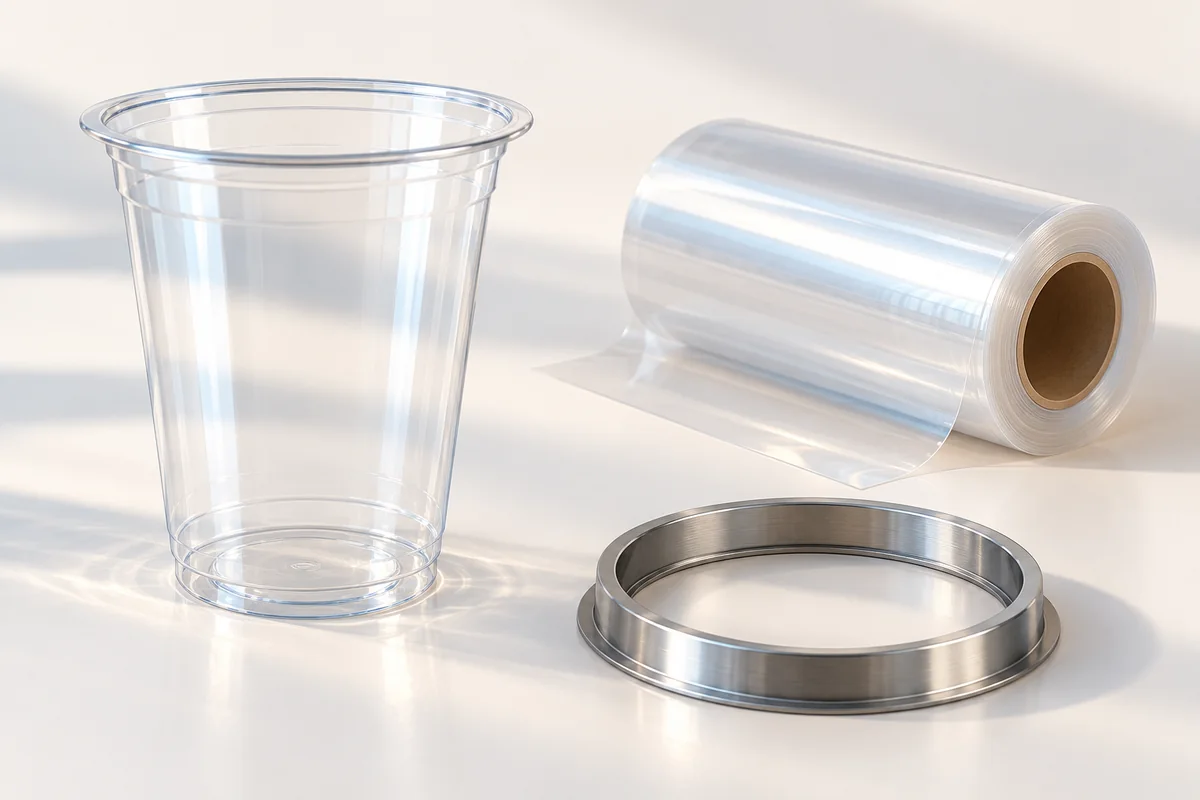
Start with the pack you need to hand to the customer
A cold drink served through a straw and a dessert opened with a spoon can need different opening behaviour. State whether the customer should pierce the film, peel it off completely, or use another agreed opening method. Include the contents, filling temperature, fill level, storage conditions, expected holding time and handling before opening. These are inputs for selecting and testing the package, not a shelf-life claim.
For procurement, separate material bonding from mechanical fit and the finished pack's behaviour. Each answers a different question. A cup may sit in a holder while its film fails to bond; a film may bond while the finished lid is difficult to open. Obtain an answer for each part of the job.
| Decision | What must be established | Useful evidence |
|---|---|---|
| Material bonding | The specified film's sealing surface is intended for the exact cup-rim material. | Film technical sheet, cup material information and the film supplier's application advice. |
| Mechanical fit | The cup, support, sealing head and film-cutting arrangement work together. | Cup drawing, installed tooling identification and machine supplier's review. |
| Finished-pack use | The seal and opening behaviour meet the agreed use conditions. | A trial using identified samples, stated conditions and recorded results. |
Check the sealing surface on the exact cup
A cold-cup description does not establish that the rim is designed for film sealing. Ask the cup supplier to identify the intended sealing surface and provide a rim drawing or section view where available. The top-view photograph shows the overall outline; the section view helps explain where the film will contact the rim and where the machine will support it.
For that surface, request the relevant dimensions and the supplier's limits for rim width, thickness and flatness, together with the cup's outside diameter, height and body profile. The equipment supplier needs to check how those features meet the holder and sealing head. Do not create a minimum sealing width or tolerance by measuring a catalogue photograph.
An ordinary cold cup is a candidate only when its actual rim and material can be assessed for the proposed process. A cup advertised for heat sealing still needs to be matched to the selected film and equipment. A snap-on lid fitting the cup does not answer either question; the separate cup-and-lid guide covers that closure.
WJPETCUP's published cup dimensions help identify models for an enquiry. They do not, by themselves, confirm a heat-sealable rim or a validated film-and-machine combination. This guide does not designate any WJPETCUP model as heat-seal approved.
Specify the sealing layer, not just “PET film”
The film's structural material and the surface that forms the seal are different pieces of information. Ask for the exact film manufacturer, grade, construction, thickness and sealing side, plus the container materials that the supplier identifies for that grade. A broad material name cannot replace this specification.
Two original-manufacturer examples illustrate the distinction below. They concern named lidding films for the applications described in their own documents. They are not recommended substitutions for a beverage-cup film and have not been qualified here with WJPETCUP cups.
| Published film example | What its manufacturer specifies | What the buyer should take from it |
|---|---|---|
| Mylar OL2 | PET film with a polyester heat-seal layer on one side; the sheet describes a firm peelable seal to listed materials including APET and CPET. | Check the actual seal layer and named receiving material, then obtain application-specific advice. |
| Toray XL7 | The data sheet shows separate PET and sealant layers and describes peelable seals to PP trays. | A PET structural layer does not mean the film is specified only for PET containers. |
Match the cup to the installed tooling, not the machine label
Send the equipment supplier the machine's nameplate model, current cup-holder or mould reference, cup drawing and intended film details. Confirm the supported rim profile, cup height and body clearance, the sealing-head contact area and the cutting arrangement. A holder that accepts the cup is only one part of this check.
Do not assume a 98 mm cup can replace a 95 mm cup in an existing 95 mm mould. Ask whether the machine needs a different holder, adapter or matched tooling set. The required parts depend on the actual machine design; a removable ring is not evidence that every nearby diameter is supported. Obtain the manufacturer's approved configuration before arranging a trial.
Model names can also be misleading if read as dimensions. For example, Y-Fang's current YF-98S page lists its maximum cup size as 95 × 95 × 180 mm and tells buyers to check material and size compatibility. Those are specifications for that manufacturer's product, not a WJPETCUP recommendation or a statement about every machine carrying a similar name.
For a machine advertised as universal, request the supported cup formats and the exact tooling supplied. Use samples of the proposed cup and film in the assessment; the marketing description cannot identify the condition or configuration of the machine already in your shop.
Agree the roll format and cut outline before ordering film
Film width and cup diameter describe different things. The film supplier and equipment supplier need to agree a roll that fits the machine and provides the required coverage through sealing and cutting. There is no useful universal rule such as “add a fixed number of millimetres to the cup diameter” without the tooling layout.
Supply the film-width requirement from the machine specification, along with the permitted roll outside diameter, core size, winding direction and sealing-side orientation. For printed film, also confirm the print repeat and any registration mark—the mark the sensor uses to position the film. Obtain these requirements for the actual machine and tooling, rather than copying another shop's roll.
The WECAN WCS-F1 manual, for example, identifies a film-loading direction and tracking sensor and requires the cup size to match the mould. Toray's XL7 sheet separately identifies the sealable surface and winding direction. These are examples of why roll format and orientation belong in the enquiry, not installation instructions for another machine.
| Item | Question to resolve before purchase |
|---|---|
| Roll width | Does the width meet the machine specification and the intended cutting layout? |
| Finished film outline | Will the cut film cover the intended seal area and leave any required grip tab? |
| Roll and core dimensions | Can the roll mount, unwind and be collected using this machine's specified arrangement? |
| Winding and sealing side | Which face must contact the cup, and how must the roll be wound for the specified film path? |
| Print repeat and registration mark | Does the printed layout match the machine's positioning method and cut position? |
Plan easy peeling and a grip tab as two requirements
Peelability describes how the seal separates when the customer pulls the film. A tab provides somewhere to grip. A visible tab does not turn a permanent seal into a peelable one, and a peelable film does not by itself define a convenient tab.
For a proposed tab, ask the packaging and tooling suppliers to review one drawing showing the cup outline, intended seal area, finished film-cut outline and the area left available for gripping. Establish which parts of the cup, film layout or cutting tool would have to change. Do this before ordering cups or printed film if a later peel-tab upgrade is part of the plan; do not assume it can be added by a machine setting.
For dessert cups intended to open completely, specify what a successful opening looks like: the user can start the peel, continue around the rim and remove the film as intended. Ask how tearing, fragments, residue and product spillage will be assessed. Mylar's OL2 sheet notes that thinner grades may tear during peeling, especially when chilled. This is a grade-specific caution that illustrates why “peelable” does not automatically mean intact removal under every condition.
Assess opening behaviour separately from simply seeing whether a seal holds. Agree the method and acceptance limits for your cup and application before the trial.
Use a trial that answers the purchasing decision
Begin with identified samples of the cup and the proposed finished film, including its printing or other finishing where relevant. Have the equipment supplier confirm the installed tooling and the permitted operating setup. If a sample, film grade or tool is substituted, record the change before treating the result as evidence.
Agree the trial scope before starting: sample quantity and selection, contents, fill level, filling and storage conditions, handling, opening method and acceptance criteria. Assess the cup's seating and support, film positioning and cutting, then seal formation and the finished pack's required performance. Visual observations can identify incomplete contact, wrinkles or deformation, but a neat-looking seal alone does not establish the required containment or opening performance.
Use the film and equipment suppliers' advice to establish appropriate temperature, contact time and pressure conditions for the combination. Record the settings and how they were checked. This guide provides no common temperature or dwell time for PET cups. A film data sheet's laboratory seal-strength result is not a ready-made machine recipe or a specification limit for your finished pack. A sealing-head setpoint is not the cup's permitted filling or serving temperature. Confirm the cup's intended temperature range separately; a successful rim-sealing trial does not establish suitability for hot drinks, hot filling or reheating.
Check opening after the planned holding and chilling conditions, where applicable, as well as immediately after sealing if that matters to the operation. Agree any containment or handling assessment separately and record the actual observations. The trial establishes only the conditions assessed; it does not create a food shelf life or prove every transport scenario.
Keep the approval attached to the cup model and version, film grade and thickness, machine and tooling references, operating conditions and intended use. When a supplier changes one of these, review which evidence remains relevant before accepting the substitution. The sample-approval article provides a wider record-keeping framework.
| Observed result | What it tells you | What still needs an answer |
|---|---|---|
| The cup sits in the holder. | The identified sample can be placed in that holder. | Sealing-head contact, cutting, material bonding and finished-pack performance. |
| The film remains attached after sealing. | A bond was observed under the recorded conditions. | The agreed containment, handling and opening requirements. |
| A chilled sample peels off as intended. | That sample met the recorded opening observation. | Other agreed checks and whether the assessment covers the order's exact combination. |
Send one specification to the cup, film and equipment suppliers
Bring the three suppliers into the same decision using a concise specification. Include the exact cup model and rim information; film manufacturer, grade, thickness and roll format; machine model and installed tooling; and the intended drink or dessert, filling, holding, handling and opening requirements. State which parts are already fixed and which can change.
For example, a hypothetical shop replacing a 95 mm PP cup with a 98 mm PET cup should ask two separate questions: which tooling configuration accepts the new cup, and which film grade seals to its rim with the required opening behaviour? Confirmation of the first does not answer the second. This is an illustrative purchasing situation, not a WJPETCUP test or conversion offer.
Ask each supplier to mark what is confirmed by its documents, what needs sample assessment and what would require a different component. Request the proposed trial arrangement before committing to bulk cups or printed film. This turns “Will it work?” into a specific combination the parties can evaluate.
WJPETCUP is a packaging manufacturer founded in 2008. For all PET products and PET printing orders, the minimum is 5000 pieces per model. Printed samples take 7–10 calendar days after both final artwork approval and receipt of sample payment; bulk production is timed from receipt of the initial payment, with duration based on the actual quantity. These are order conditions, not a promised heat-sealing trial schedule. Use the production-schedule guide for planning.
Read more
Discuss a defined PET cup sealing requirement
Send the cup model you are considering, your machine and tooling references, any current film specification, and how the finished pack should be filled and opened. Ask which cup information is available and what the film and equipment suppliers need to assess.