
Revised ·
Check what the quantity and dimensions refer to
A quantity field by itself is ambiguous: it might describe pieces per bag, pieces per carton or an order quantity. Likewise, cup dimensions and carton dimensions describe different objects. Before calculating, obtain a record that explicitly identifies the outer carton and the pieces packed in it.
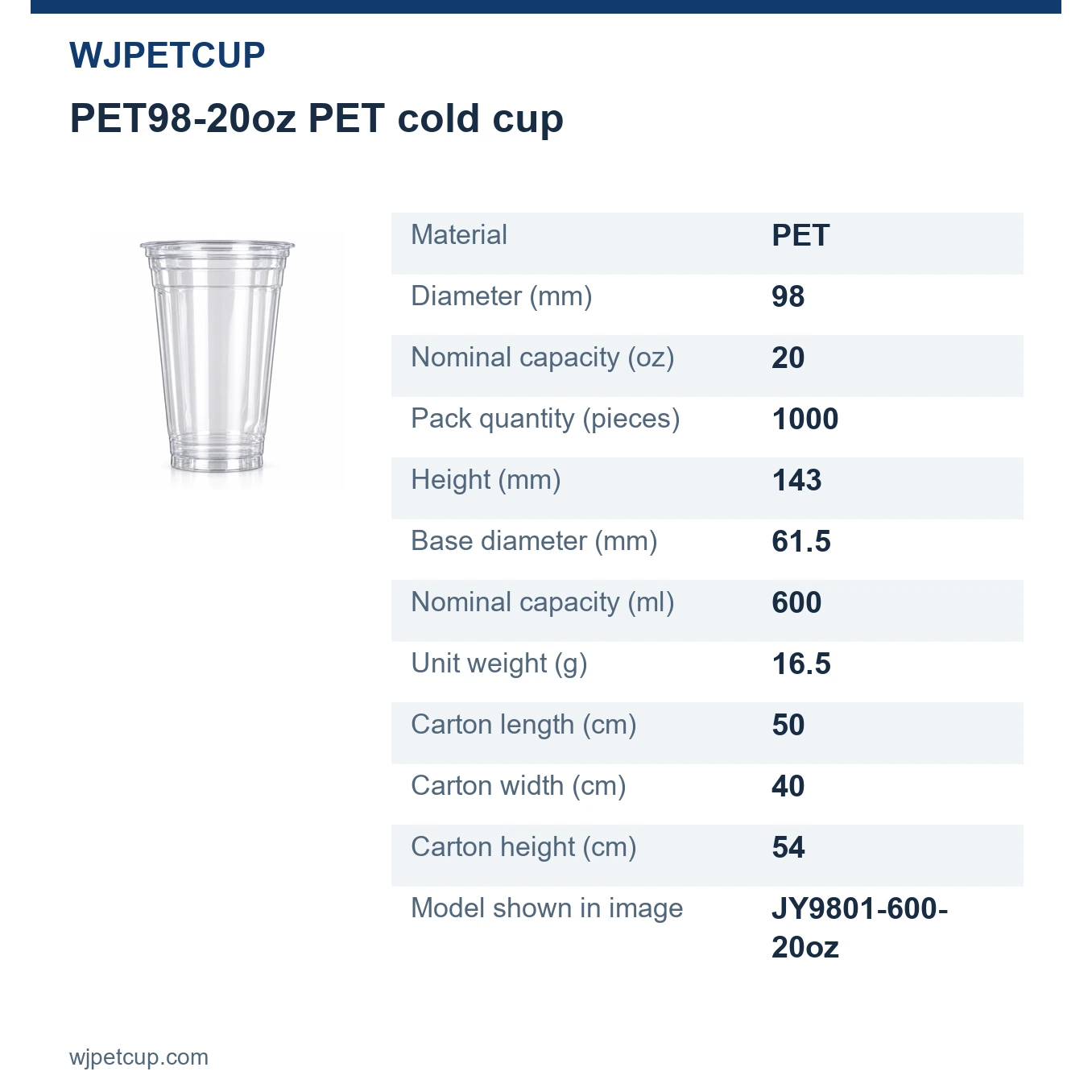
For the examples below, the supplied catalogue identifies carton dimensions and states 1000pcs per carton for JY9801-600-20oz cups and JY-98FL lids. These are catalogue packing records, not a final packing list. The order calculation applies only if the packing list confirms those quantities and carton dimensions for the shipment.
Keep cups and lids on separate lines. Ordering enough lids for every cup does not mean the two components share a carton size, and it does not mean a quoted cup price or packing quantity includes the lids. Each line needs an identified model and its own packing basis.
Convert centimetre dimensions to cubic metres
For rectangular outer-carton dimensions stated in centimetres, nominal volume in cubic metres equals length × width × height ÷ 1000000. The divisor follows from converting each of the three dimensions from centimetres to metres. Keep all three inputs in the same unit before multiplying.
The cup carton example is 50 × 40 × 54 ÷ 1000000 = 0.108m³. The lid carton is 41.5 × 21 × 52 ÷ 1000000 = 0.045318m³. The lid occupies a smaller nominal carton volume in this particular comparison, but these figures do not establish a freight saving without the rest of the shipment and quotation conditions.
Do not multiply individual cup capacity by the number of cups to estimate shipment space. The products are packed as a group, and carton dimensions describe the shipping envelope. Drink volume and outer-carton volume serve different purposes.
| Model | Carton dimensions (cm) | Calculation | Nominal volume per carton (m³) |
|---|---|---|---|
| JY9801-600-20oz cup | 50 × 40 × 54 | 50 × 40 × 54 ÷ 1000000 | 0.108 |
| JY-98FL lid | 41.5 × 21 × 52 | 41.5 × 21 × 52 ÷ 1000000 | 0.045318 |
Calculate the two order lines separately
Consider an illustrative order of 5000 cups and 5000 lids. If the final packing list confirms 1000 pieces per carton for each of the two models above, the calculation is five cup cartons plus five lid cartons. This is a planning example, not an actual WJPETCUP shipment or a promise that the two models have passed a fit test.
Five cup cartons contribute 5 × 0.108 = 0.54m³. Five lid cartons contribute 5 × 0.045318 = 0.22659m³. Their sum is 0.76659m³ of nominal carton volume. This total includes both component lines; calculating only the cups would omit the lids' shipping space.
For several models, repeat the operation for every packing line and add the results. Do not average carton sizes first: that can hide a change in either model quantity or packing arrangement. A line-by-line record is easier to revise when one specification changes.
| Order line | Pieces | Confirmed packing assumed | Cartons | Nominal line volume (m³) |
|---|---|---|---|---|
| JY9801-600-20oz | 5000 | 1000 pieces/carton | 5 | 0.54 |
| JY-98FL | 5000 | 1000 pieces/carton | 5 | 0.22659 |
| Total | 10000 components | Two separately packed models | 10 | 0.76659 |
How many cartons should I budget for 5,000 pieces of one 107 mm cup model?
The company confirmed on 2026-11-06 that the 30 oz JY-1000-30oz and standard 32 oz JY-1000-32oz currently contain 600 pieces per carton. The standard 32 oz carton width is 34.5 cm. Identify the exact model before using its packing quantity and carton dimensions.
For an order of 5,000 pieces of either model, eight full cartons contain 4,800 pieces, leaving 200. Allow for a ninth carton only if both parties agree to pack the balance separately, and obtain that last carton's outside dimensions and gross weight. If only full cartons can be ordered, agree the piece quantity first.
The torch-style JY107-900-32oz is currently confirmed at 500 pieces per carton, so 5,000 pieces make ten full cartons. Request freight using the final packing list, destination, outside dimensions and packed gross weight.
Know what this total does not describe
The summed carton volume does not include a pallet or additional outer protection unless their dimensions have been included in the packing record. It also does not describe the empty spaces that may remain in a loading arrangement. Dividing a vehicle or container's volume by this number is therefore not a verified loading plan.
Volume is also different from weight. Multiplying the catalogue weight of an individual cup by its quantity would omit the cartons and other packing materials. Obtain shipment gross weights for a freight enquiry instead of labelling a product-only calculation as packed weight.
A carrier's chargeable basis and rate require the actual service and quotation conditions. Do not rename 0.76659m³ as chargeable weight or a freight price. Use it as a clearly labelled planning input, then provide the confirmed packed dimensions and weights requested for the quotation.
Recheck the inputs when the packing changes
If order quantity divided by pieces per carton is not a whole number, flag the remainder. Do not silently assume a partial carton is permitted, round the supply quantity upward or treat a fractional carton as having a proportional outer size. The agreed packing arrangement must resolve that line before the final volume is calculated.
For a different lid style, carton count or custom packing requirement, update the affected line rather than reusing the earlier total. A catalogue comparison remains useful for early planning, while the dated final packing list becomes the basis for the actual shipment.
Send WJPETCUP the model-by-model quantities and any packing requirements. For the later freight discussion, keep the destination, carton counts, outer dimensions, gross weights and applicable collection or delivery arrangement together. This separates the product order from the transport assumptions and makes a changed quotation easier to explain.
Read more
Prepare model-by-model packing requirements
Send the exact cup and lid models, quantity for each model, destination and any required packing arrangement. Use the confirmed packing list to finalise carton counts and volume.