
Revised ·
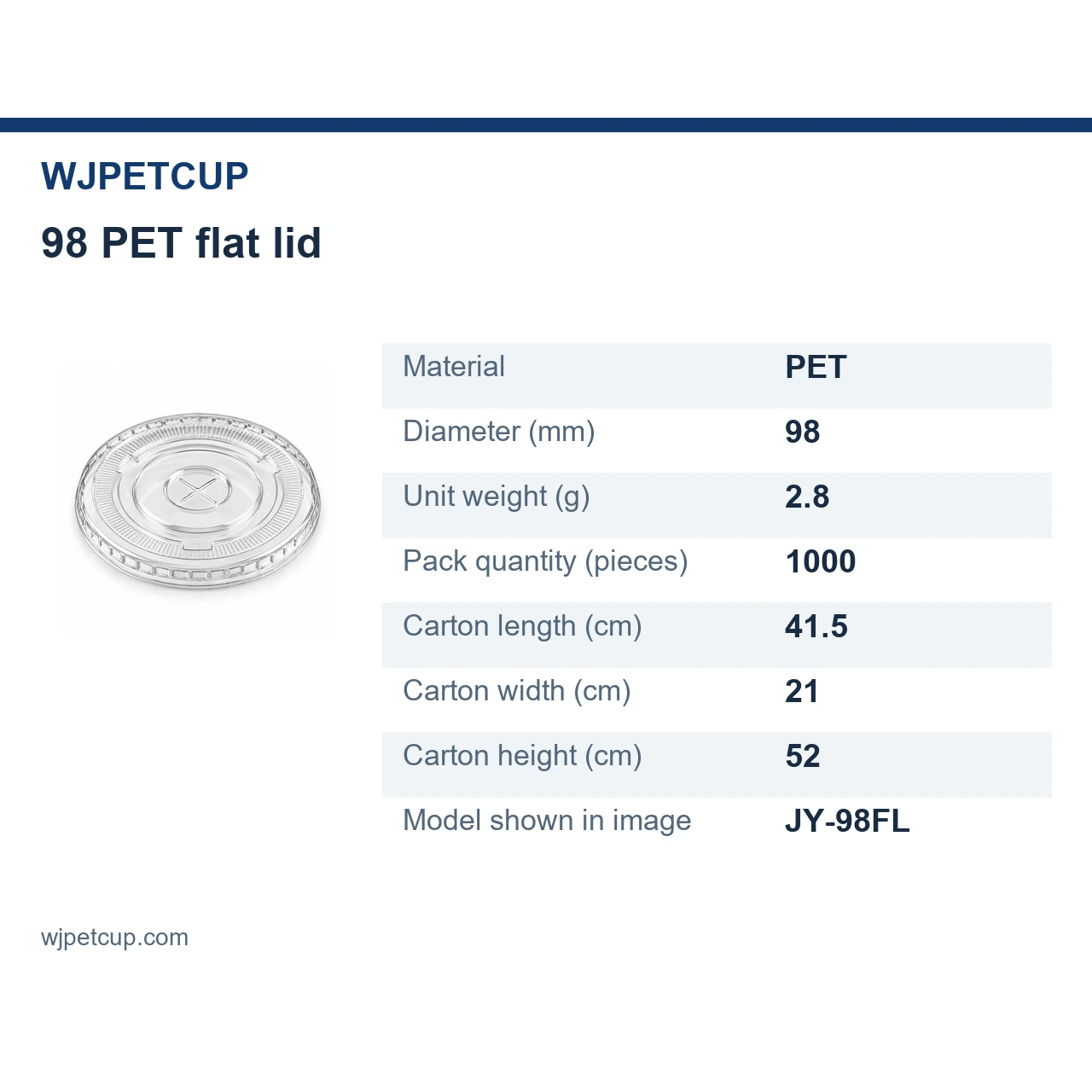
Identify the lid by model and form
The supplied catalogue shows a relatively flat top for JY-98FL, a raised rounded platform for JY-98HL and a rounded dome for JY-98DM. The company has confirmed a cross-shaped slit for JY-98DM and a small straw opening for JY-98 A. JY-98 L is labelled as a direct-drink lid. The sample brief should still identify the intended straw outer diameter and request the exact opening dimensions.
The names high and dome should not be treated as measured clearance categories. They describe catalogue forms, while the usable space under a lid depends on its actual internal geometry and how it seats on the cup. This guide does not assign an internal height or topping allowance to either model.
| Model | Form and opening | Decision to make before sampling |
|---|---|---|
| JY-98FL | Flat lid; central crossed opening visible in the source image | Is a relatively flat top and this opening arrangement appropriate for the serving? |
| JY-98HL | High lid with a raised top platform | What space must remain between the finished serving and the inside of the lid? |
| JY-98DM | Rounded dome; cross-shaped slit | How will the upper part of the serving and the chosen utensil use this shape? |
| JY-98 L | Direct-drink lid | What drinking access and orientation must the sample provide? |
| JY-98 A | Lid with small straw opening | Will the intended straw diameter and insertion method work with this small opening? |
Decide whether the top of the drink needs extra space
Begin with the finished serving level, including anything above the liquid. A drink with no raised topping asks a different clearance question from one presented with a shaped topping. Describe the part of the serving that must remain undisturbed when the lid is applied, rather than simply requesting a high lid.
A dome may be worth evaluating when the serving extends upward, but the name alone does not show whether the actual topping clears the inside surface. A raised platform has a different outline from a rounded dome. Compare the sample assembly at the intended fill level and inspect the space where the serving comes closest to the lid.
Do not estimate capacity from the apparent size of the top in a photograph. The published product images help identify the item; they do not provide a measured internal volume. If clearance is critical, make that a recorded requirement and obtain the relevant measurement or sample observation.
Treat the access opening as a separate choice
Lid shape and opening are related, but they answer different questions. The shape concerns the space above the cup; the opening concerns how the customer reaches the contents. A lid can have the top form you want and still leave the access question unresolved.
For a straw-based serving, identify the intended straw and how it is inserted and used. The source image of JY-98FL shows a crossed opening; the company has confirmed a cross-shaped slit for JY-98DM. The available information provides neither opening dimensions nor insertion-force results. The 98 mm figure describes the lid rim diameter and does not verify fit with a particular straw diameter.
For direct drinking, JY-98 L is the catalogue starting point. Review the actual drinking opening and the way the cup is held. JY-98 A is now confirmed as a lid with a small straw opening; check the intended straw with a sample of this model. Opening dimensions and cup-and-lid fit remain unverified. None of these labels is a promise that the assembled package is spill-proof.
Keep style approval and fit approval distinct
A buyer can approve the appearance of a dome while still waiting for evidence that it seats correctly on the chosen cup. Recording those as separate decisions prevents an attractive catalogue image from being treated as approval of the complete package.
For an illustrative review, pair the proposed cup model with JY-98DM and record two open items: whether the top shape suits the intended serving, and whether that exact cup-and-lid assembly satisfies the agreed handling conditions. If the first answer is yes and the second is unresolved, the package remains unapproved. This is a review example, not a claim that the combination has been tested.
The same separation helps with later substitutions. Replacing a lid with another 98mm version changes the component even if the nominal rim size stays the same. Revisit the affected observations instead of carrying the old approval across automatically.
Send a lid request that identifies the serving
A useful enquiry names the cup model, candidate lid model, finished serving level, additions above the liquid and intended drinking or utensil access. Include any carrier or presentation constraint that the added lid height must respect. This is enough to explain why you are considering a particular form.
Keep dimensions not supplied by the catalogue visibly open. WJPETCUP can discuss the named models and the evidence needed for your selection, without treating an unknown opening size or an untested fit as a confirmed specification. The fit-verification and sample-record guides take over once the style shortlist is ready.
Read more
Shortlist a lid for your serving
Send the exact cup model, candidate lid and the access or top-space requirement you need to evaluate. Keep any untested combination marked as pending.