
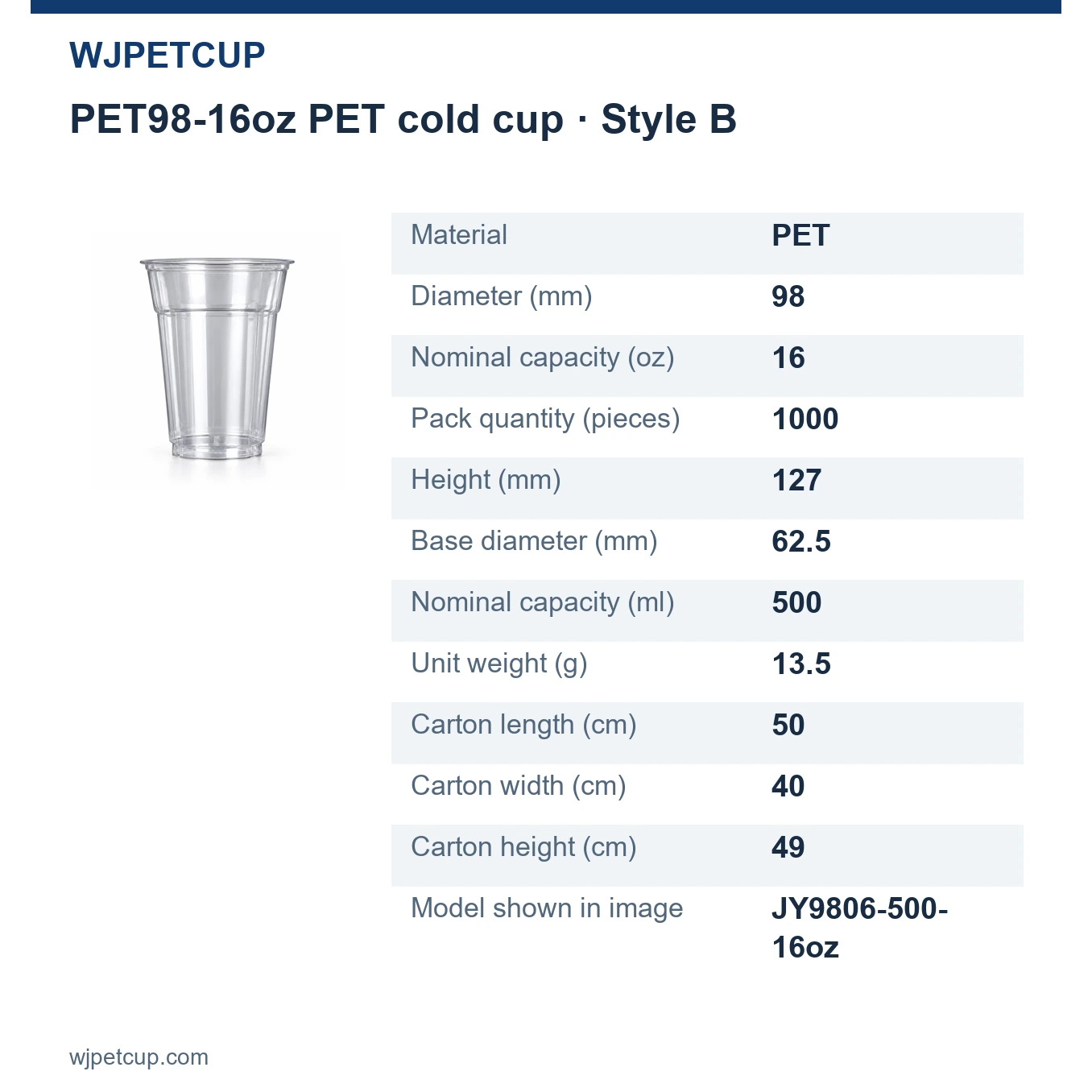
What changes between four 16oz models
The following records identify four separate cups. The dimensions are catalogue values, not measured production tolerances. The millilitre figures are also catalogue labels; they are not a promise that the cup will hold that amount of your finished drink with ice, toppings and the selected lid.
Read across a row to identify one item. Read down a column to compare one physical constraint. For example, JY8903-500-16oz is listed at 138mm high, while JY95-500-16oz is 124mm high. Their 14mm difference matters when you are planning an overall package height, but the installed lid and required working clearance still have to be added.
| Model | Rim diameter (mm) | Height (mm) | Base diameter (mm) | Catalogue capacity label (mL) |
|---|---|---|---|---|
| JY8903-500-16oz | 89 | 138 | 52.5 | 460 |
| JY93-500-16oz | 93 | 135 | 59.5 | 500 |
| JY95-500-16oz | 95 | 124 | 64 | 500 |
| JY9806-500-16oz | 98 | 127 | 62.5 | 500 |
Start with what cannot change in your operation
For an existing beverage line, the fixed item may be the lid, a cup carrier, a sealing setup or the space below a dispenser. Name that constraint before comparing appearance. A new cup can share the old 16oz label and still require a different component or a fresh fit check.
If you are retaining an existing lid, its exact identity matters more than the drink-size name. A rim-size match is a useful first filter, but it does not establish the locking geometry or the performance of the assembled pair. Keep an untested combination marked as a candidate. The cup-and-lid verification guide covers the evidence needed after shortlisting.
If the whole package can change, shortlist the body and lid together. This gives you freedom to compare a wider, shorter body with a narrower, taller one without assuming that all existing accessories will transfer. The tradeoff is a broader sample review, because you are changing more than one component.
Use height and base diameter to ask better sample questions
Rim diameter describes only the top of the cup. It cannot tell you whether the lower body sits correctly in a carrier or how the cup feels when held. In the table, the 89mm model has a 52.5mm base, while the 95mm model has a 64mm base. That is a real dimensional distinction worth taking to a sample review, not proof that one cup is more stable.
A carrier may contact the cup above its base, where the body is wider. Checking only the base against the carrier opening can therefore miss the relevant contact point. Identify where the carrier supports the cup and evaluate the actual combination. Do not turn a catalogue drawing into a carrier-fit guarantee.
The same principle applies to printed graphics. Total cup height is not printable height. Once a body is selected, use the model-specific printing layout to decide the logo position. Selecting the body first prevents a design approved for one outline from silently being transferred to another.
Separate the drink requirement from the container label
Describe the finished serving before treating a catalogue capacity as suitable: liquid portion, ice or solid additions, intended final level and lid style. A menu name such as medium or 16oz does not supply those details. Recording them allows two candidates to be reviewed against the same serving requirement.
For an illustrative brief, a buyer might keep one recipe and compare the 95mm and 98mm models shown above. The comparison would keep the drink preparation unchanged and record the final level, lid clearance and handling observations separately for each sample. No successful result is assumed; the purpose is to avoid changing the recipe and the cup at the same time and losing track of what caused the difference.
A larger catalogue millilitre figure is not automatically the better choice. The useful outcome is a cup that satisfies the defined serving and service constraints, with a named lid and an approved physical sample. The separate capacity guide explains why fluid-ounce conversion does not settle that decision.
Finish with a model-based shortlist
Keep the shortlist small enough to compare deliberately. For each candidate, record its full model, the constraint it appears to satisfy and the observation still needed. A note such as “JY95-500-16oz: shorter body candidate; carrier and lid combination pending” is more useful than “16oz cup approved”.
Send WJPETCUP the selected model links, the existing components you need to retain and the serving setup to evaluate. This turns a broad enquiry into a decision about specific cups, while leaving untested fit and fill requirements open for the correct next step.
Read more
Compare a specific 16oz cup shortlist
Send the models you are considering and describe the lid, carrier or serving constraint you need to keep. Include the drink preparation you want to assess on samples.